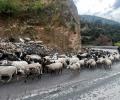
The edited sheep contains no foreign DNA, distinguishing it from transgenic organisms and paving the way for regulatory approval under India's evolving biotech policy framework.

The varieties will take at least 4 to 5 years to reach farmers after they complete the usual cycle of breeder, foundation and certified seeds.
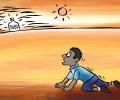
Algorithmic management (AM) in India has led to a decline in job quality, with "clear" evidence of increased monitoring, surveillance and work intensity, noted International Labour Organisation (ILO) in its latest report.
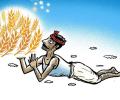
India's policy for agriculture trade must move commodity-by-commodity to gain maximum benefits as US President Donald Trump's 26 per cent tariff on exports from the country take effect, said agriculture economist Ashok Gulati in a recent policy paper.

Skymet expects a good monsoon over western and southern India.

Seafood is one of India's largest agricultural exports after basmati rice and buffalo meat.
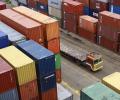
The US Trade Representative noted that India's average applied tariff rate stood at 17% per cent, the highest of any major world economy.

Of the 823,000 new subscribers in January, the share of young people (18 to 25 age group) declined to 57.07% (470,000) from 57.28% (485,066) in the preceding month.

After declining to a three-year low in FY24, the private sector investment is expected to fall further in the current financial year, India Ratings said in a research note.. The investments in the private sector are likely to plummet to below 11 per cent of the GDP in FY25, based on the trends from the latest national accounts data and company fillings, it noted.
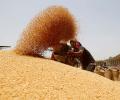
Wheat production during the current season is expected to be better than last year provided the weather remains favourable over the next few weeks, said senior industry executives. The weather had turned uncharacteristically hot in the latter half of last month, but owing to strong winds, the chill has returned in the last few days.
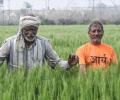
'Rainfall does not appear to have a statistically significant impact on foodgrain production since the last few years, which contrasts with the traditional view of India's heavy reliance on monsoon rains for agriculture.'

Women on an average gave 10 minutes more to "employment-related activities" and spent 7 minutes less on "unpaid domestic services for household members" per day in 2024 against what they did five years ago in 2019.
'The size of the investments is important, but equally crucial is the number of jobs that these proposals create.'
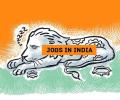
Unemployment rate in urban areas during the third quarter (October-December) of FY25 remained unchanged at 6.4 per cent compared to the preceding quarter, according to the latest quarterly Periodic Labour Force Survey (PLFS) data released by the Ministry of Statistics on Tuesday. While the unemployment rate for men worsened marginally to 5.8 per cent in Q3 from 5.7 per cent in Q2, for women, it improved to 8.1 per cent from 8.4 per cent.
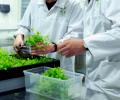
Several leading scientists, academicians, and agriculturalists have called for raising government support for research and development to make Indian agriculture future-ready.

The government may save over Rs 70,000 crore (Rs 700 billion) on capital and revenue expenditure allocated towards new schemes in the FY25 Budget that are yet to be implemented.

The upcoming Union Budget to be presented on February 1 is likely to assume a nominal gross domestic product (GDP) growth between 10 and 10.5 per cent for FY26, a Business Standard poll of 10 economists showed. The first advance estimates released by the National Statistics Office (NSO) had estimated a nominal GDP growth of 9.7 per cent for FY25. Nominal GDP, calculated at current market prices, factors in the effect of inflation. It is used as the base to calculate crucial macroeconomic indicators, such as fiscal deficit, revenue deficit, and debt-to-GDP ratio.
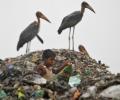
State Bank of India (SBI), in a report on Friday, claimed a significant decline in the headline poverty ratio in rural areas on account of enhanced physical infrastructure, higher consumption growth in the bottom fractile and direct benefit transfers (DBTs).
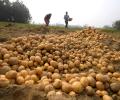
Amid the political blame game over Bengal's potato ban, which led to shortages in Jharkhand and Odisha, Uttar Pradesh farmers are the unlikely winners.
 © 2025 Rediff.com - Investor Information - Advertise with us - Disclaimer - Privacy Policy - Sitemap - Feedback - About us - Terms of use - Grievances